
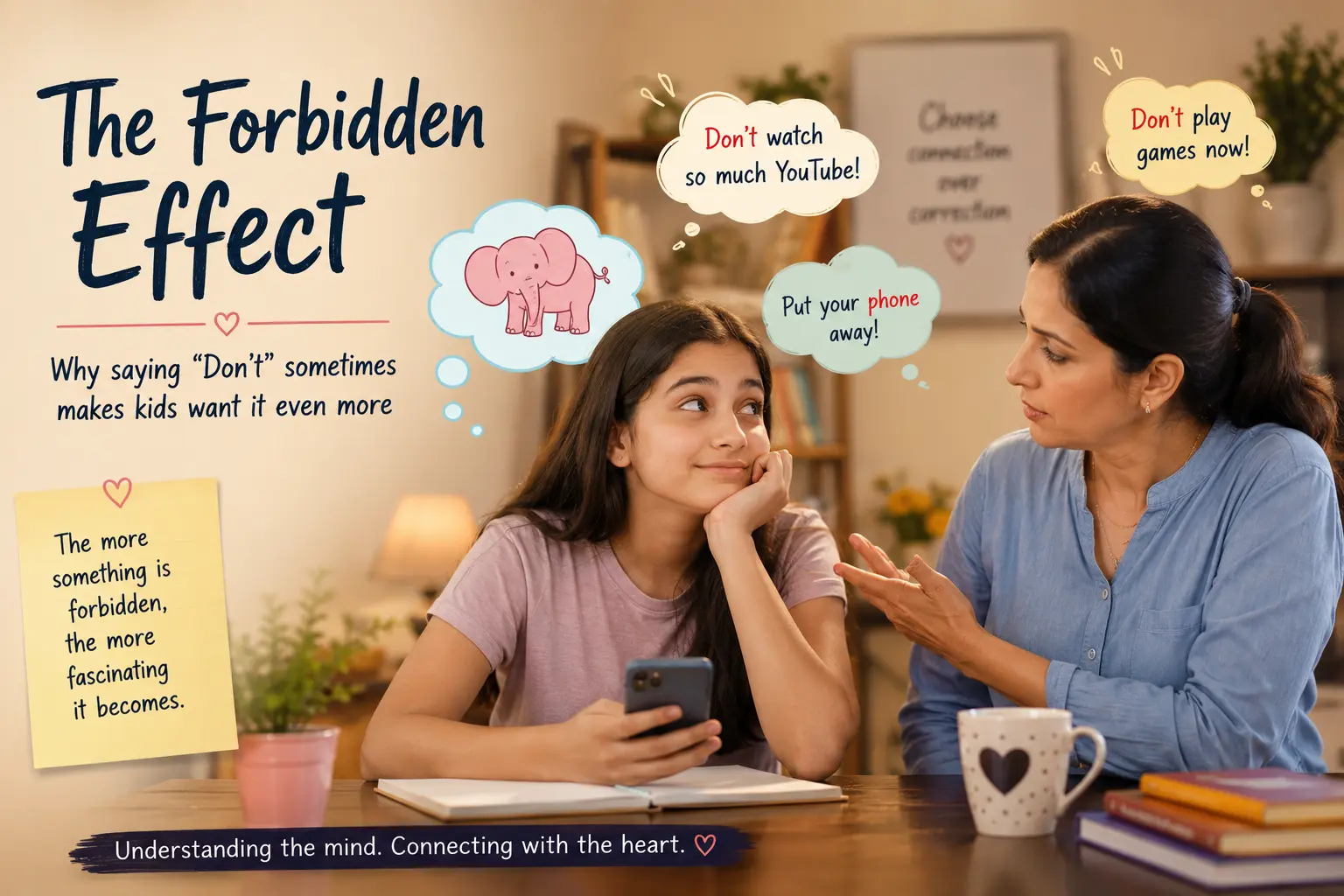
The Forbidden Effect: Why Saying “Don’t” Sometimes Makes Kids Want It Even More
“Don’t touch that.”
“Don’t spend so much time on your phone.”
“Don’t watch YouTube all day.”
“Don’t play games now.”
If you’ve ever raised a child or even been one, you’ve probably noticed something strange.
The moment something becomes forbidden, it suddenly becomes irresistible.
Psychologists call this The Forbidden Effect—the tendency for our minds to become even more focused on something once we’re told not to think about it or not to do it.
It isn’t stubbornness alone.
It’s simply how the human mind often works.
Sarah’s Daily Battle
Sarah was a loving mother.
Every evening, she found herself repeating the same sentences to her fourteen-year-old daughter, Clara.
“Clara, enough YouTube.”
“Put your phone away.”
“You’ve already played for two hours.”
“Go read something.”
At first, Clara listened.
Then she began negotiating.
Five more minutes.
One more video.
One last game.
Eventually, those five minutes became an hour.
Sarah grew frustrated.
The more she tried to pull Clara away from her phone, the more Clara seemed attached to it.
It almost felt as though the phone had become more attractive simply because her mother wanted it gone.
One evening, Sarah walked into Clara’s room.
“As soon as I tell you not to use your phone,” she sighed, “it’s like you want it even more.”
Clara looked up and smiled.
“Maybe.”
She didn’t know why.
Neither did Sarah.
A Simple Experiment
The next weekend, Sarah decided to try something different.
Instead of saying,
“Don’t use your phone.”
She said,
“We’re making pancakes together. After that, you can decide how you’d like to spend the next hour.”
No lectures.
No arguments.
No commands.
Just a choice.
Something unexpected happened.
Clara helped in the kitchen.
She laughed.
She stole chocolate chips while Sarah pretended not to notice.
By the time breakfast was over, Clara picked up her phone.
She watched one short video.
Then she put it down again.
Sarah was surprised.
Nothing magical had happened.
The phone hadn’t become boring.
It had simply stopped being forbidden.
The Pink Elephant
There’s an old psychological exercise.
Someone tells you,
“Whatever you do, don’t think about a pink elephant.”
What happens?
Almost everyone immediately imagines one.
Not because they wanted to.
Because the instruction itself directs attention toward it.
Children experience something similar.
When they constantly hear,
“Don’t watch.”
“Don’t play.”
“Don’t do that.”
Their attention remains fixed on the very thing adults hope they’ll forget.
The forbidden object quietly becomes the most interesting object.
It’s Not Just Children
Adults aren’t very different.
Tell yourself,
“I absolutely must not check my phone.”
Suddenly you want to check it.
Start a strict diet.
Now all you can think about is chocolate cake.
Tell yourself not to text someone.
You begin wondering whether they’ve texted you.
Our minds often mistake restriction for importance.
If something demands so much control, perhaps it must be valuable.
The Lesson Sarah Learned
Sarah eventually realized she wasn’t fighting a phone.
She was fighting human psychology.
That didn’t mean Clara needed unlimited screen time.
Children still need boundaries.
But boundaries work best when they come with understanding instead of constant prohibition.
Instead of making every conversation about what Clara couldn’t do, Sarah started creating reasons to enjoy what she could do.
Movie nights.
Cooking together.
Gardening.
Evening walks.
Board games.
The phone slowly became just another object in the house instead of the center of every argument.
Sometimes Less “Don’t” Creates More “Do”
Children don’t always rebel because they’re disobedient.
Sometimes they rebel because curiosity grows inside locked doors.
Perhaps that’s why the forbidden fruit has appeared in stories across cultures for centuries.
The more something is presented as forbidden, the more fascinating it becomes.
Maybe the goal isn’t to remove every temptation.
Maybe it’s to make real life interesting enough that temptation loses some of its shine.
After all…
The mind has a strange habit.
It often wants most what it believes it cannot have.
Final Reflection
The next time your child reaches for their phone after you’ve asked them not to, pause for a moment before assuming they’re being difficult.
Ask yourself:
Am I fighting the phone… or am I accidentally making it more desirable?
Sometimes, changing how we guide children changes how they respond.












Leave a Reply