
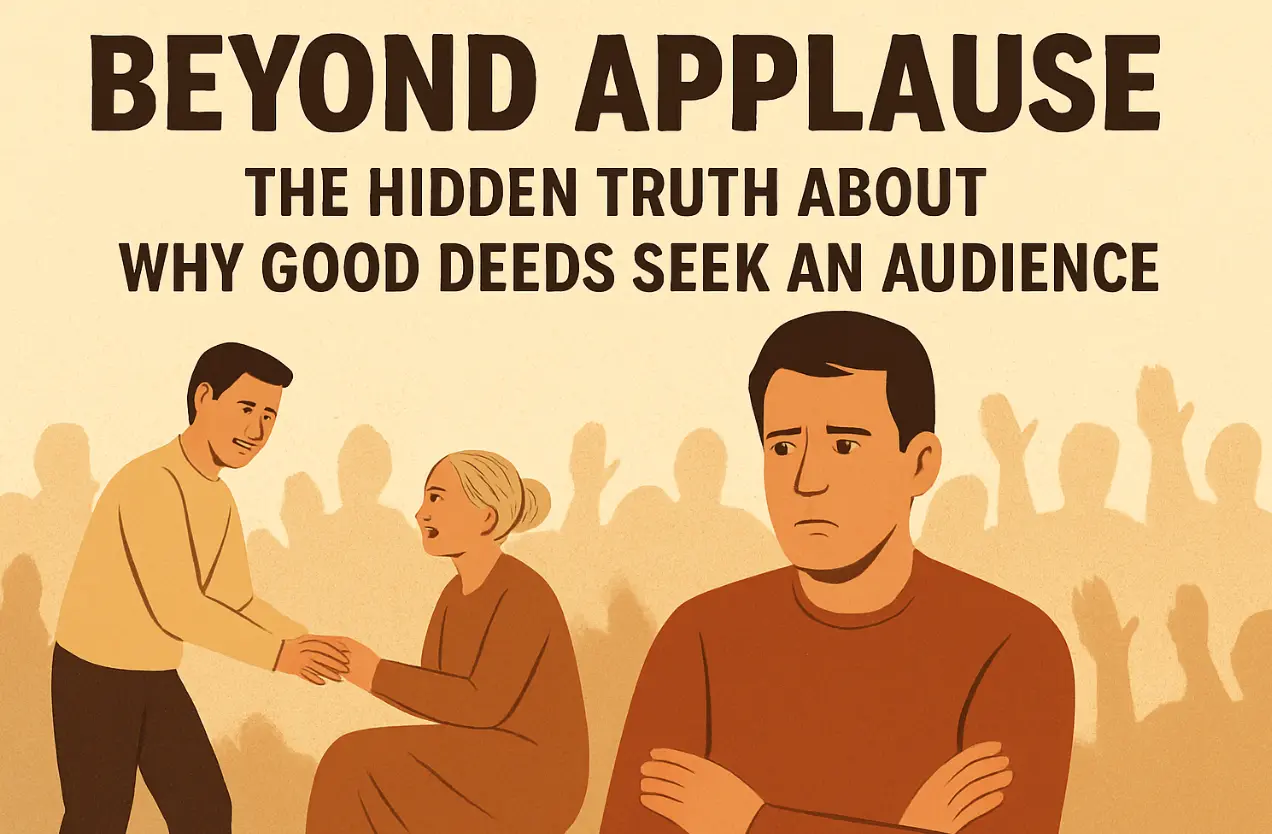
Beyond Applause: The Hidden Truth About Why Good Deeds Seek an Audience. Uncovering Why People Perform Good Deeds Only When Eyes Are Watching.
Arjun was known in his small town as a humble man who never boasted about anything. He lived a simple life, tending to his little bookstore and helping neighbors when they needed a hand. Yet, something had always puzzled him: every time someone else performed a good deed, they seemed eager for applause, for the world to see and praise them. Why was that?
One evening, as Arjun closed his shop, he noticed a small crowd gathered near the riverbank. Curious, he approached and saw a young man, Ravi, standing proudly beside an elderly lady who was rescued from the water. Ravi basked in the attention, smiling broadly as people clapped and took pictures.
Arjun frowned. “Why do you make it so public?” he asked Ravi later, as the crowd dispersed.
Ravi chuckled, “Isn’t it obvious? People need to see we do good things. Otherwise, how will they know we are better than others? If no one sees it, did it even happen?”
Arjun remained silent for a moment. “But does the world’s applause change the act itself?” he asked softly. “Or the person who performs it?”
Ravi looked puzzled but shrugged it off. “Of course it does. People admire heroes. They remember those whose deeds were loud and proud.”
Arjun walked home, his mind troubled. He remembered his own childhood, watching his father help people in silence. No one applauded him, and no one wrote about his kindness in the local paper. Yet, somehow, that silent goodness seemed more profound, more genuine.
That night, as the stars shone above, Arjun thought deeply. He realized that the real value of an action was not in its visibility but in the purity of its intention. When someone helps another simply to be seen, the action becomes a performance. But when the help is offered from the heart, unseen by the world, it holds a different weight—a quiet nobility.
True Kindness Doesn’t Need Crowds, and Ego Does
Arjun resolved to continue his path, helping in silence, not for fame but because it was right. He understood now that the measure of good lies not in the applause of others but in the satisfaction of a clear conscience.
Moral Reflection:
In a world obsessed with likes, shares, and public recognition, the quiet, selfless acts of kindness often go unnoticed. Yet, true goodness doesn’t demand an audience. It thrives in the silent chambers of our conscience, away from the spotlight. Our actions gain meaning not by how many eyes witness them, but by the purity of the intention behind them.
“Doing good for the spotlight is like watering a plastic plant—pointless and fake.”
Why do people feel the need to showcase their good deeds? Perhaps it stems from an intrinsic desire to validate their worth in the eyes of others, as if applause could wash away their unspoken sins. It is easier to hide faults and failures from the world, but when it comes to goodness, society has conditioned us to believe that visibility equates to virtue.
Philosophically, an action detached from noble intent is like a tree bearing no fruit—showy but empty. The moral compass points not toward performance but toward purpose. The highest form of virtue is to perform good solely for the benefit of others and for one’s spiritual growth, without expectation of acknowledgment.
After all, it is said that God looks not at what is done, but why it is done. The silent helpers, the unseen doers, they alone walk the path of true righteousness. In the end, what matters is the soul’s purity, not the applause of the crowd.












Leave a Reply