
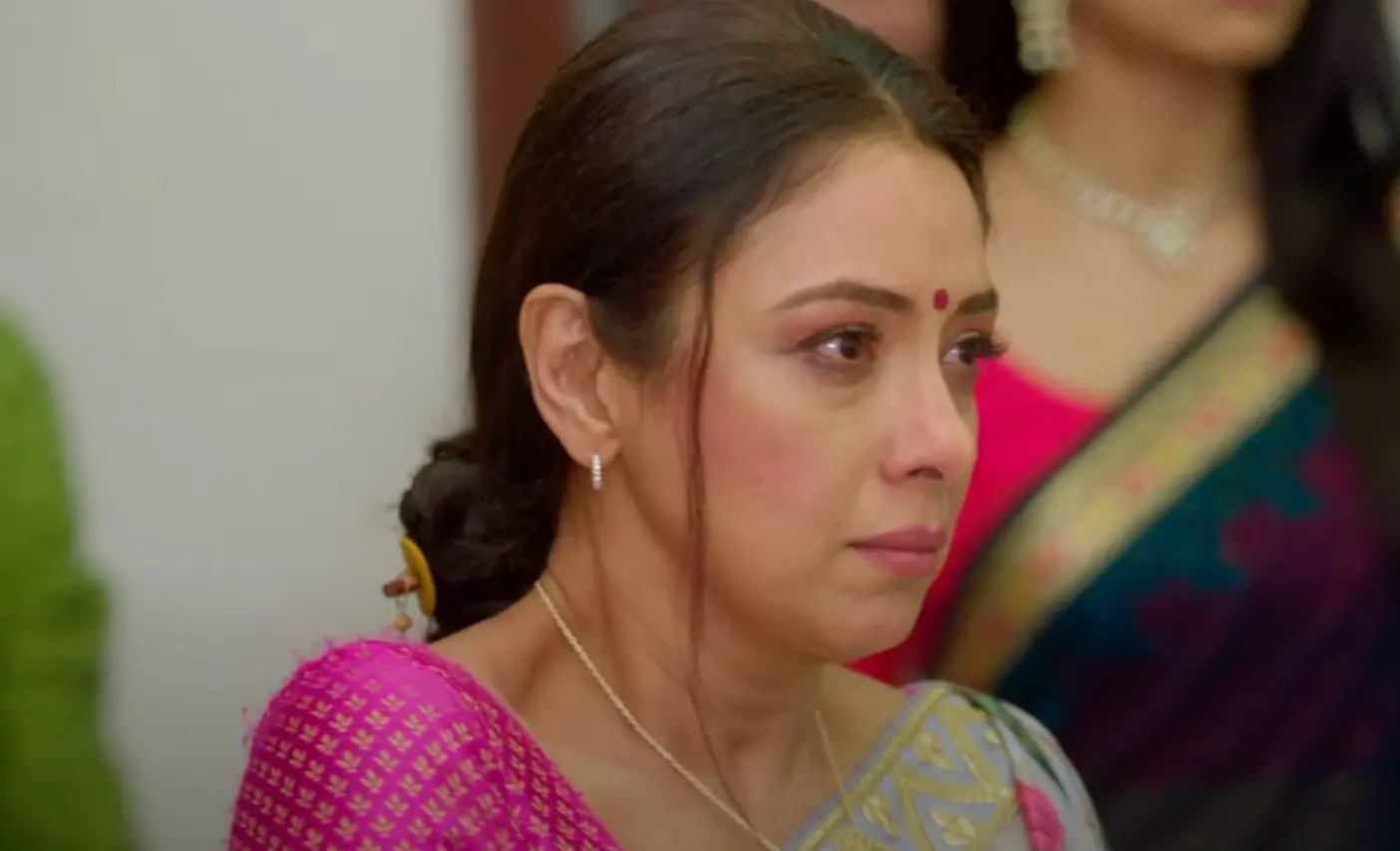
Anupama 21st October 2025 Written Update: The Day Evil Meets Its End. The village turns into a courtroom today, with Anupama standing tall as both the witness and the judge of truth. She walks straight into the heart of deception and drops truth bombs that shatter every lie Prakash and Sonu have built around themselves.
Anupama, fierce as ever, reveals that Sonu tries to kill Girija not once but twice. Her voice doesn’t tremble even for a second as she exposes the filth hiding behind the fake halo of respect these men wear. She tells everyone that Sonu and Prakash have not only ruined Girija’s life but also molested several innocent girls while pretending to be the village’s protectors. The crowd gasps, but Anupama isn’t done yet.
When Girija and two other girls step forward to support her, the truth becomes louder. The girls speak, trembling yet brave, naming Prakash for his predatory ways. But instead of guilt, Prakash chooses arrogance. He laughs off the accusations, calling Anupama a manipulative witch who has “poisoned” the minds of innocent girls. The man even goes as far as saying that Anupama should be burned this Dusshera, like some twisted Ravana’s fantasy.
Anupama’s reply hits him like divine thunder. She reminds the villagers that Prakash and Sonu have already tried to kill her and Rahi, and their wounds are living proof. Rahi steps up, her voice breaking yet steady, urging everyone to open their eyes and see what Prakash has done to them. Just when it can’t get more damning, Bharti joins in, revealing that Prakash has been using his so-called “blessings” to molest young girls. Sonu isn’t just an accomplice—he’s equally guilty.
The more they speak, the more the villagers’ blind devotion begins to crack. The same crowd that once folded hands before Prakash now whispers curses behind his back.
Anupama stands like a lioness, roaring that evil has no gender or disguise—it must be punished, even if it wears a saint’s robe. She drops another bombshell—Sonu murdered her son and walked free thanks to money and influence. “Search it online,” she challenges, because truth doesn’t fear Google either.
Prakash laughs mockingly, as if she’s gone mad. But Anupama looks him dead in the eye and says, “The women standing here are not ordinary. They are the nine forms of Goddess Durga.” The line strikes like fire. The villagers’ faith shifts—not toward Prakash, but toward themselves.
As the women rise together, the men’s fake power begins to crumble. Sarita, once Prakash’s loudest supporter, admits her mistake. She says she was a blind follower, duped like the rest, and now she sees his true face—ugly, dark, and demonic.
Anupama compares Prakash, Sonu, and Tatiya to Ravana, Meghnath, and Kumbhkaran, calling them the perfect trio of hypocrisy. Her words carry both anger and disappointment. “You trusted these men,” she scolds, “and sent your daughters to them, unaware of their filth.”
Then comes the final blow—from Prakash’s wife. She stands there, trembling yet strong, and says, “A wife should stand by her husband, but never by his sins.” Silence falls. Even the air feels heavy with shame.
Meanwhile, chaos brews elsewhere. Prarthana, searching for water, nearly slips onto broken glass. Gautam rushes forward and saves her in time. Prarthana screams, and the Kotharis come running. Ansh, fuming at the sight of Gautam holding Prarthana’s hand, assumes the worst. But Gautam clarifies that he’s only protecting her, not playing hero in a love story. Vasundhara steps in, supports Gautam, and praises him for being genuine—much to Ansh’s annoyance.
Back in the main scene, Anupama isn’t done restoring order. She urges the villagers to punish Prakash—not out of vengeance, but to remind every girl that silence protects only the guilty. Prakash, Sonu, and Tatiya try to escape, but karma runs faster. The villagers catch them and rain down long-overdue justice.
Prakash, still unrepentant, fires a gun in the air to scare them off. But this isn’t the same frightened village anymore. Anupama steps in his way, stopping him and Sonu until the police arrive. The district officers admit they couldn’t act earlier because no one dared to file a complaint. Today, courage replaces silence.
When the dust settles, the villagers look at Anupama not as a victim, but as a warrior. They praise her bravery, and she reminds them one last time—stop worshipping humans as gods; only God deserves that place.
In the final act, Prakash’s wife hands Anupama the torch, asking her to burn the Ravana effigy. It isn’t just a ritual anymore—it’s justice. As the flames rise, the effigy burns along with centuries of blind faith and fear. The fire lights up faces, but it also ignites hearts. Evil burns, truth triumphs, and the women stand taller than ever before.
The episode ends not with silence—but with the sound of awakening.
Review Time: “Anupama – The Revolution We Signed Up For”
This episode is a blazing blend of social awakening and high-voltage drama, the kind that makes you want to stand up, clap, and yell, “Jai Anupama!”
Rupali Ganguly doesn’t just play Anupama—she embodies her. Every word she speaks feels like it’s cutting through generations of silence. Her performance tonight is a masterclass in power wrapped in grace.
The writers clearly decide that Dusshera this year isn’t for fireworks—it’s for fireworks of truth. The way Anupama connects Durga’s nine forms to the women’s collective strength is pure goosebump material. And Prakash’s downfall? The kind of villainy that television lives for—pathetic, proud, and perfectly crushed.
The Gautam-Prarthana-Ansh subplot gives a soft emotional breather between the storms, subtly reminding viewers that not every man mirrors evil. It balances the narrative and keeps the rhythm grounded.
The direction and cinematography are on fire—literally and figuratively. The Ravana effigy burning against the chants and flickering flames becomes a visual poem about justice. Evil doesn’t just die—it gets humiliated before it does.
If this episode had an alternate title, it would be “When the Goddess Wakes Up.”
Anupama isn’t just a character tonight—she’s a symbol of every woman who’s been told to hush, to bear, to adjust. Her fury is sacred, her calm is divine, and her victory feels personal to every viewer.
This isn’t television—it’s revolution in saree form.
← Anupama 20th October 2025 Written Update: Anupama Rises Strong










Leave a Reply