
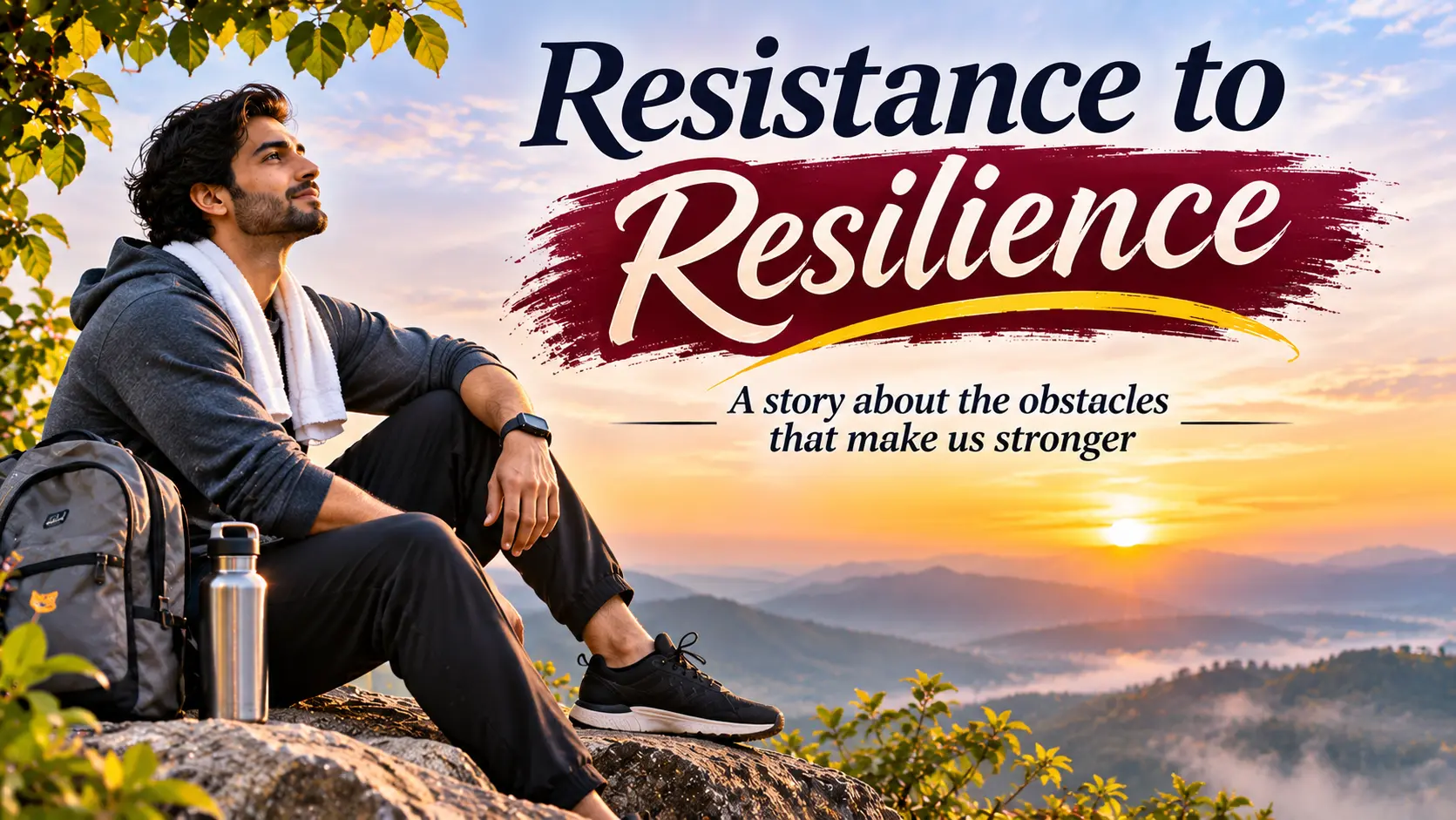
Resistance to Resilience: How Life’s Obstacles Make Us Stronger
Every morning, Alex followed the same routine. He woke up early, put on his running shoes, and headed to the small gym in his apartment building. Among all the equipment there, his favourite was an elliptical trainer.
He loved the rhythm of it. His feet moved, the handles followed, and the machine carried him through a steady workout. But what he enjoyed most was adjusting the resistance. Some days, he chose an easy setting. On other days, he increased the resistance and challenged himself to push harder.
To Alex, the numbers on the display mattered. They helped him understand how much effort he was putting in and how far he had progressed.
One morning, the machine’s power adapter stopped working.
The elliptical could still be used manually. Its pedals moved, and he could continue exercising. But the resistance settings no longer worked. The display was blank, and he couldn’t see his heartbeat or calories burned.
He tried pedalling for a few minutes, but something felt missing. The movement was there, yet the challenge was gone. He couldn’t increase the resistance or measure his effort. Eventually, he stepped off the machine, disappointed.
“What’s the point of using it if I can’t adjust the resistance or track my progress?” he wondered.
He ordered a replacement adapter and decided to wait until it arrived.
That evening, while sitting on his balcony, Alex watched a little bird struggling against the wind. It tried to fly towards a nearby tree, but every time it spread its wings, the wind pushed it backwards. For a moment, it seemed as though the bird would give up.
But it didn’t.
It adjusted its wings, gathered strength, and tried again. The wind continued to resist, yet the little bird kept moving. Finally, it reached the branch and settled there.
Alex watched in silence.
The bird had not waited for the wind to disappear. It had learned to fly despite it.
And suddenly, he thought about his elliptical trainer.
The machine had not stopped working. It could still move. What had disappeared was the resistance he could control and the display that helped him measure his performance. Perhaps he had become so accustomed to seeing progress through numbers that he had forgotten the value of simply continuing.
The thought stayed with him.
Resistance Is Part of the Journey
The next morning, Alex returned to the gym. The replacement adapter had not arrived, but this time he stepped onto the elliptical anyway.
He began pedalling manually.
There were no numbers to encourage him, no calorie count to celebrate, and no resistance level to challenge him. He had only his own effort and determination.
For the first few minutes, he missed the familiar display. Then he realised something important: he did not need a machine to tell him that he was moving. He could feel his muscles working. He could feel his breathing change. He could recognise his effort without seeing it on a screen.
He continued.
It made him think about life. How often did people become discouraged when things stopped going according to plan? How often did they mistake difficulty for failure, or assume that progress had ended simply because the journey had become harder?
Life, too, has its resistance.
Sometimes it comes in the form of rejection, disappointment, delayed opportunities, difficult relationships, or responsibilities we never expected to carry. At other times, it is the quiet struggle of waiting for something we desperately want.
We often wish these things would disappear. We imagine that life would be wonderful if everything moved smoothly, if every door opened easily, and if every effort brought immediate results.
But would we discover our strength if nothing ever challenged us?
A muscle grows when it works against resistance. A person develops patience when things take time. Courage emerges when fear stands in the way, and confidence grows when we realise that we can survive what once seemed impossible.
Resistance does not always mean that we are moving in the wrong direction. Sometimes, it means that we are being asked to become stronger before reaching the next stage of our journey.
Not Every Resistance Is Meant to Be Defeated
Alex also understood that resistance was not something to welcome blindly.
There are challenges worth facing, and there are situations that only drain us. Sometimes strength means pushing forward. At other times, it means changing direction, taking a break, or accepting that a particular path is no longer right for us.
The lesson was not to struggle endlessly. It was to stop believing that every difficult moment was a sign to give up.
A smooth road may take us somewhere, but a challenging journey can teach us who we are along the way.
The Journey Needs Both
A few days later, the new adapter arrived. Alex plugged it in, and the elliptical came back to life. The display lit up, the resistance settings worked, and the familiar numbers appeared.
He smiled and increased the resistance.
This time, though, he looked at the machine differently. He no longer saw resistance as an inconvenience or merely a setting to adjust. He saw it as an essential part of the experience.
He realised that life needs both thrust and resistance.
Thrust gives us the energy to begin. It is the dream that pulls us forward, the ambition that makes us take the first step, and the hope that keeps us moving.
Resistance tests that energy. It teaches us discipline, reveals our abilities, and gives meaning to the effort we make.
Without thrust, we may never begin. Without resistance, we may never discover how far our strength can take us.
And perhaps that is one of life’s quiet truths: we should not spend all our time wishing for an easier journey. We should also learn to recognise the strength we gain from the difficult parts.
The next time life pushes back, don’t immediately assume that you are losing. You may simply be discovering a strength you haven’t needed before.
Thrust gives life its direction, but resistance gives the journey its meaning.
So keep moving. Adjust your pace when necessary. Change direction when you must. Rest when you need to.
But don’t mistake the presence of resistance for the absence of progress.










Leave a Reply