
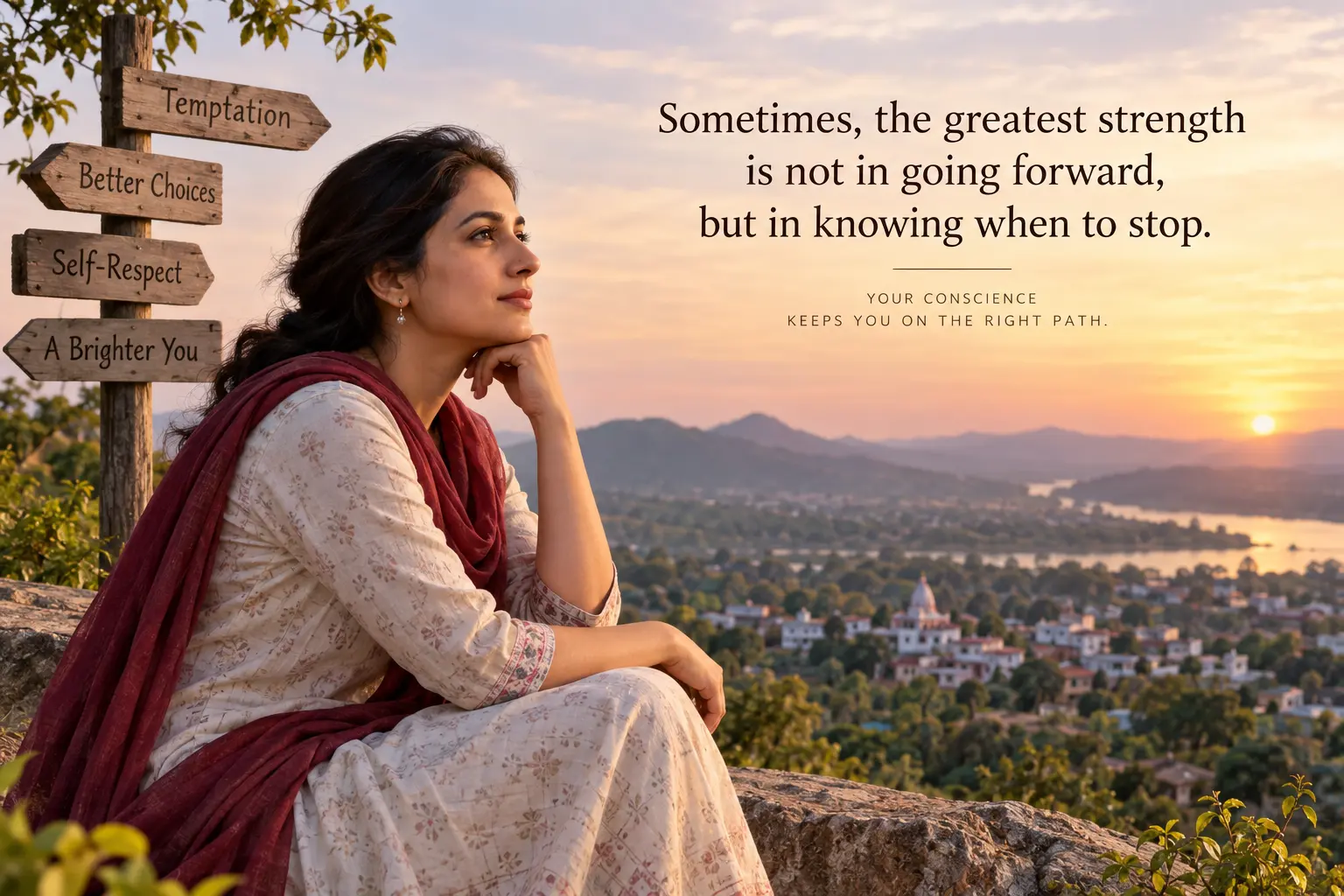
The Edge of the Soul: Your Conscience Keeps You On The Right Path. A Moral Story About Conscience, Temptation, and the Courage to Walk Away
In the small town of Madhavpur, where everyone seemed to know everyone else’s business, lived a woman named Meera.
She was thirty-eight, a schoolteacher, and a person people trusted without hesitation. She helped neighbors with their problems, taught children after school without charging those who couldn’t afford it, and never hesitated to speak the truth, even when the truth made her unpopular.
People often praised her.
“Meera has such a strong character.”
“She knows how to live with dignity.”
“Women like her are becoming rare.”
Meera would smile whenever she heard such words, but she never considered herself extraordinary. She simply believed that a person should be able to look into a mirror without feeling ashamed of the choices they had made.
Her mother had taught her something when she was young.
“The world will give you a thousand reasons to change your values. Make sure you don’t lose yourself while trying to fit into it.”
Meera had carried those words for years.
But she had also learned that life wasn’t as simple as the advice people offered.
Sometimes, the hardest battles weren’t fought against the world.
They were fought within oneself.
The Things People Don’t See
Meera lived with her mother, Savitri, in an old house near the town’s temple. Her husband, Raghav, worked in another city and returned home every few weeks. Their marriage wasn’t unhappy, but the years had quietly replaced many conversations with responsibilities.
Bills. Household matters. Her mother’s medicines. Raghav’s work.
They cared about each other, but there were days when Meera felt as though she had become invisible inside her own life.
Nobody asked her what she wanted anymore.
Nobody noticed when she was tired.
And sometimes, she wondered whether she had spent so much time being dependable that she had forgotten how to be understood.
She never spoke about these feelings. Not because she wanted to deceive anyone, but because she didn’t know how to explain a loneliness that existed even when she wasn’t alone.
Then Arjun returned to Madhavpur.
He had grown up in the same town but had spent several years working in the city. He came back to manage his family’s business and soon became a familiar face at the local community center, where Meera occasionally volunteered.
Arjun was articulate, observant, and easy to talk to. Unlike many people who spoke to Meera only about her responsibilities, he asked about her opinions.
“What do you think about this?”
“Why did you choose teaching?”
“Do you ever feel you could have done something different with your life?”
The questions surprised her.
At first, she answered casually. Then she began looking forward to their conversations.
Arjun made her laugh. He noticed when she changed her hairstyle. He remembered little things she said.
One afternoon, after a community meeting, he told her, “You know, Meera, everyone in this town sees you as someone who can handle everything. But I wonder whether anyone ever asks if you need someone to handle things for you.”
She looked at him.
For a moment, she didn’t know what to say.
It was an ordinary sentence.
Yet it touched a place inside her that had been quiet for a long time.
When Attention Begins to Feel Like a Need
Over the following weeks, Meera and Arjun spoke more frequently.
Sometimes about the town. Sometimes about their childhoods. Sometimes about things they hadn’t told many people.
Meera knew she enjoyed his company. She also knew that enjoying someone’s attention wasn’t, by itself, a wrongdoing.
But she began noticing a change in herself.
She checked her phone more often.
She felt disappointed when he didn’t call.
She started keeping some of their conversations private, even when there was no obvious reason to hide them.
Whenever the thought made her uncomfortable, she dismissed it.
“We’re just friends. Why am I making such a big deal out of it?”
That was how the first compromises often arrived—not as dramatic decisions, but as explanations.
One evening, her friend Naina visited her.
They sat on the veranda while Savitri rested inside.
“You seem distracted lately,” Naina said.
“Just tired.”
“Is everything okay?”
Meera smiled. “Why wouldn’t it be?”
Naina studied her for a moment but didn’t press further.
After she left, Meera remained on the veranda, listening to the distant sound of a motorcycle passing through the lane.
She wondered why a simple question had made her defensive.
She knew the answer, but she wasn’t ready to say it aloud.
The Town That Made Wrong Things Look Ordinary
Madhavpur had its own unwritten rules.
People judged those who broke them, but they also admired those who managed to escape consequences.
A shopkeeper who cheated customers was called clever.
A businessman who lied about his accounts was praised for knowing how to survive.
A man who broke promises was forgiven with a shrug.
“Everyone does it,” people would say.
Meera had always disliked that sentence.
One afternoon, she overheard two women discussing a local man who had betrayed someone’s trust.
“What’s the big deal?” one of them said. “People should learn to move on. Nobody is perfect.”
Meera said nothing.
But later, she found herself thinking about it.
Perhaps she had been too strict.
Perhaps people really did make mistakes and continue living.
Perhaps the world didn’t care about the boundaries she had spent her life protecting.
And if everyone else could bend their principles, why did she always feel responsible for keeping hers intact?
The thought frightened her—not because she suddenly agreed with it, but because she recognized how easily a person could begin using the behavior of others to excuse their own.
The Invitation
A few days later, Arjun invited Meera to a private gathering at a farmhouse outside town.
“Nothing complicated,” he said. “Just a few friends. You need a break from your routine.”
Meera hesitated.
“Who else is coming?”
“People you know. Don’t worry so much.”
She didn’t immediately say yes.
That evening, she mentioned the invitation to Raghav during a phone call. He was exhausted after work and responded absentmindedly.
“Go if you want. You deserve some time for yourself.”
His words were kind, but the conversation ended quickly.
Meera put down the phone.
She felt an unexpected sadness.
She wanted someone to ask her how she felt, not merely tell her that she was free to go.
When Arjun messaged again, she agreed to attend.
The gathering was pleasant at first. There was music, food, and conversation. Some people drank, others laughed loudly, and everyone seemed determined to forget the pressures of everyday life.
Meera found herself relaxing.
She had missed feeling carefree.
Arjun stayed close to her throughout the evening. He spoke to her with the same warmth that had drawn her toward him, but now there was something more deliberate in his attention.
At one point, they moved away from the others and stood beneath the trees.
“You always think too much,” he said.
“Someone has to.”
He laughed. “You know what your problem is? You want to be good all the time.”
Meera looked at him. “Is that a problem?”
“Not unless you make it one. You deserve to live for yourself too.”
She didn’t answer.
There was truth in his words, or at least a part of truth. She did deserve happiness. She did deserve to have her own wishes.
But she sensed that the conversation was moving toward something she didn’t want to name.
Arjun took a step closer.
Meera’s heart began beating faster.
Not because she had made a decision, but because she realized she was standing at a place where a decision might soon be required.
The Moment Before the Fall
The music from the farmhouse reached them faintly.
Arjun spoke softly.
“Why are you always afraid of what people will think?”
Meera looked away.
“I’m not afraid of people.”
“Then what are you afraid of?”
She wanted to say that she was afraid of losing herself.
But the words remained inside her.
For a brief moment, she imagined what it would feel like to stop thinking about consequences. To stop being the woman everyone expected her to be. To simply follow the emotions she had kept under control for so long.
The possibility felt both exciting and deeply unsettling.
And then, without warning, she remembered her mother.
Not her advice as a sentence, but a particular evening from years earlier.
Meera had been sixteen. She had broken a neighbor’s window while playing and wanted to pretend she hadn’t done it. Savitri had held her hand and walked her to the neighbor’s house.
“Tell the truth,” she had said.
“But what if they get angry?”
“Then let them be angry. You must still be able to live with yourself.”
Meera had cried that day. She had apologized. The neighbor had eventually forgiven her.
The memory returned now with extraordinary clarity.
She looked at the ground beneath her feet.
Nothing dramatic had happened. No one was shouting. No one was forcing her to do anything.
Yet she knew she was approaching a boundary she had no desire to cross.
She also understood something that frightened her more than the temptation itself:
A person doesn’t always fall because someone pushes them. Sometimes they fall because they keep telling themselves that one more step won’t matter.
Arjun noticed her silence.
“What happened?”
Meera took a step back.
“I think I should leave.”
He frowned. “Why? Did I do something?”
“I don’t want this conversation to go any further.”
“You’re overthinking again.”
“Maybe I am.”
She picked up her bag.
“But I still know what I want to do.”
Arjun’s expression changed. “You’re making this more serious than it is.”
Meera looked at him calmly.
“Perhaps. But I don’t want to wait until it becomes something I cannot undo.”
She walked toward the farmhouse.
Her hands were trembling.
She wasn’t proud of how close she had come. She wasn’t pretending that her feelings had never existed. And she wasn’t blaming Arjun for every thought she had entertained.
She was simply choosing to stop.
The Walk Home
The road back to Madhavpur was quiet.
Meera walked part of the way before arranging a ride. The night air was cool, and the lights from the distant houses appeared like small, steady stars.
She expected to feel relieved.
Instead, she felt a strange mixture of sadness, embarrassment, and anger at herself.
Why had she allowed things to reach that point?
Why had she enjoyed the attention so much?
Why had she needed someone else to remind her that she was worth noticing?
She didn’t have easy answers.
And for the first time in weeks, she stopped trying to find an excuse.
She had been lonely.
She had enjoyed being admired.
She had allowed herself to move closer to a situation that conflicted with her values.
None of those truths needed to be denied.
But neither did they have to determine what she did next.
When she reached home, Savitri was awake, sitting near the window.
“You came late,” her mother said.
“Yes.”
“Everything all right?”
Meera sat beside her.
For a while, she said nothing.
Then she asked, “Amma, have you ever been afraid of making a mistake?”
Savitri smiled faintly.
“Many times.”
“What did you do?”
“Sometimes I made the mistake. Sometimes I stopped myself. And sometimes I spent years wishing I had stopped sooner.”
Meera lowered her eyes.
Savitri didn’t ask for details.
She simply placed her hand over Meera’s.
“Remember one thing,” she said. “Your conscience is not there to punish you. It is there to help you recognize the person you want to remain.”
Meera felt tears fill her eyes.
She leaned against her mother’s shoulder, just as she had done when she was a child.
The Truth About Being Good
The next morning, Meera went to school as usual.
She taught her classes, corrected notebooks, and helped a student who was struggling with a mathematics problem.
The world had not changed.
Nobody knew what she had experienced the previous night.
At lunchtime, Naina called her.
“How are you?”
Meera considered giving her the usual answer.
“I’m fine.”
Instead, she said, “I’m trying to understand myself.”
Naina remained quiet.
Meera continued, “Sometimes I think being a good person means never having the wrong thoughts, never feeling tempted, never wanting something complicated.”
“That sounds exhausting,” Naina replied.
Meera let out a small laugh.
“It is.”
“Maybe being a good person means being honest about what you’re feeling and responsible for what you choose.”
Meera looked out through the classroom window.
The schoolyard was filled with children running beneath the afternoon sun.
“I think I’m beginning to understand that.”
She didn’t tell Naina everything. She wasn’t ready. But she no longer felt the same need to hide her internal struggle from herself.
Over the next few days, Meera created distance from Arjun.
She didn’t insult him. She didn’t spread stories about him. She didn’t pretend that he had ruined her life.
She simply made her boundaries clear.
When he sent her a message asking whether she had changed her mind, she replied:
“No. I have decided what is right for me, and I intend to respect that decision.”
Then she put her phone away.
The decision didn’t erase her feelings overnight.
But it gave her something more valuable than temporary excitement.
It gave her peace with herself.
The Edge of the Soul
Several months later, Meera took her students on a school trip to a hill overlooking Madhavpur.
The children ran along the safe walking path, laughing and pointing toward the valley below.
Meera stood near the railing and watched the landscape stretch into the distance.
She thought about how easily a person could mistake freedom for the absence of boundaries.
She thought about how often people confused goodness with weakness.
And she thought about the night at the farmhouse.
She had once believed that a strong person was someone who never felt the pull of temptation.
Now she knew better.
Strength wasn’t the absence of desire, loneliness, curiosity, or vulnerability.
Strength was the ability to recognize when a choice was taking her away from the person she wanted to be.
The ability to pause.
The ability to say no.
The ability to walk away, even when nobody would applaud her for doing so.
A student approached her.
“Ma’am, why are you standing here alone?”
Meera smiled.
“Just thinking.”
“About what?”
She looked at the valley.
“About how important it is to know when to stop.”
The child frowned. “Stop what?”
Meera laughed softly.
“Anything that might hurt you if you keep going.”
The student nodded, apparently satisfied, and ran back to the others.
Meera remained where she was.
Below, the valley opened into the town, where people continued their ordinary lives—making choices, making mistakes, forgiving one another, and beginning again.
She understood that she would never be immune to weakness.
No one was.
And perhaps that was why conscience mattered so much.
It wasn’t a wall that kept every difficult feeling away.
It was a light that helped a person see the edge before stepping beyond it.
Meera turned away from the railing.
Then she walked back toward her students.
Goodness is not measured by the absence of temptation, but by the courage to act with integrity when temptation appears.
We cannot always control what we feel, what others offer us, or what the world makes seem normal. But we can choose how far we go.
Sometimes, the most important decision of our lives is made in a quiet moment when nobody is watching.
A moment when we could take another step, but choose to turn back.
Not because we are afraid of the world.
Not because we believe we are perfect.
But because we understand that some things, once lost, are difficult to recover—and our peace of conscience is worth protecting.
If you ever found yourself standing at the edge of a decision that could change how you see yourself forever, would you have the courage to step back?
Or would you convince yourself that one more step could never do any harm?
← Your New Home for TV Serial Written Updates and Upcoming Episodes | TellyReviews







Leave a Reply