
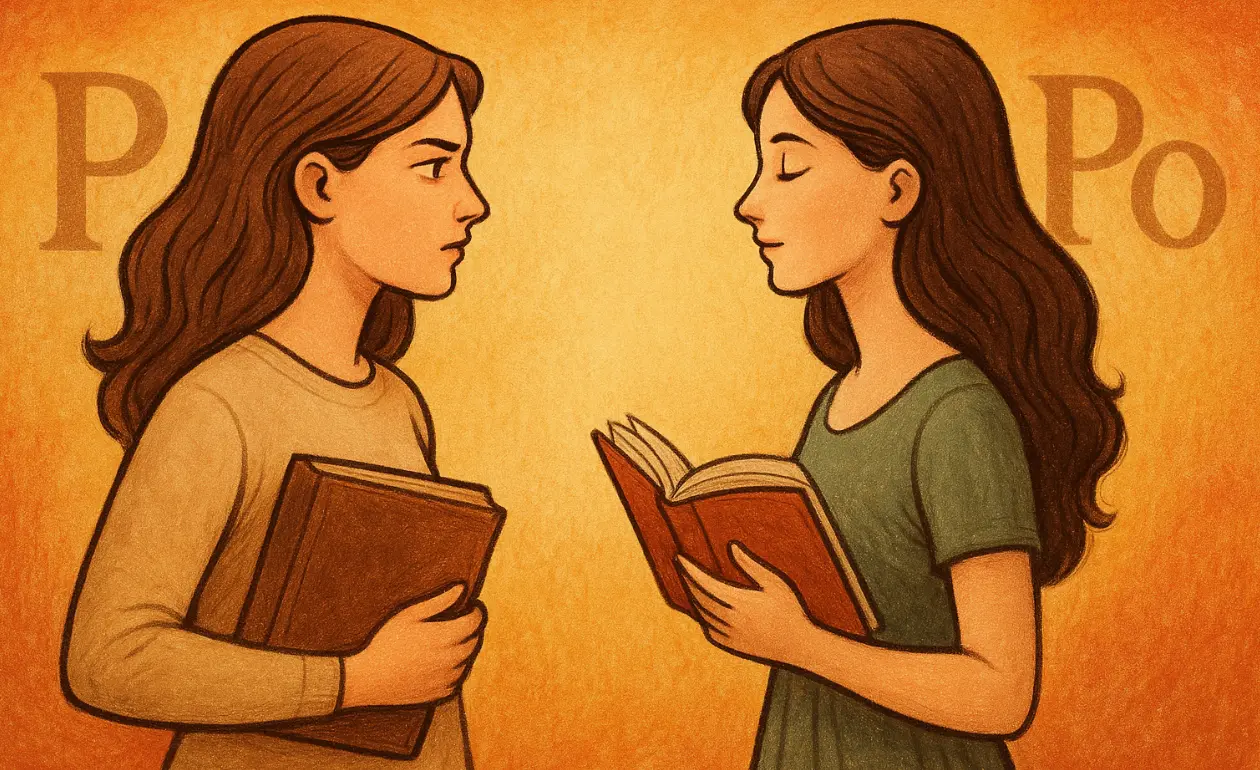
Clash of Creativity: Prose vs. Poetry – Who Wins the Crown? In the quaint town of Elmsworth, where creativity blossomed like wildflowers in spring, two girls stood out as the brightest stars of their generation. Amelia was known for her eloquent prose—structured, clear, and sharp like a well-carved sculpture. Clara, on the other hand, was a poet whose words danced in the air like a melody, subtle yet profound, capable of evoking emotions with the gentlest whisper.
Both attended the prestigious Elmsworth Academy of Arts, and it wasn’t long before whispers of rivalry began to stir. The town loved debates, and the upcoming “Words’ Conclave” offered the perfect stage for a friendly yet fierce competition: Prose vs. Poetry.
Amelia was methodical, analytical, and articulate. Her prose was like a strong oak tree—steady, reliable, and grounding. She argued that prose was the backbone of literature. Every novel, essay, and article was built upon prose. “Prose is direct, logical, and precise,” she claimed, “It gives clarity and conveys meaning without ambiguity. It shapes thoughts into structure.”
Clara, with a soft smile and a twinkle in her eye, countered, “Poetry is the heartbeat of language. It touches what prose often can’t—the raw, unspoken emotions, the rhythm of life itself. A single verse can capture the vastness of sorrow or the sweetness of joy in a way that pages of prose struggle to convey. Poetry lives in the silences between words.”
The day of the competition arrived, and the auditorium buzzed with anticipation. Amelia presented first. She read a short story—crisp, well-organized, full of vivid descriptions and clear dialogue. Her words painted pictures of everyday life, unfolding events with precision, leaving no room for ambiguity. The audience nodded, impressed by the clarity and strength of her narrative.
Then Clara stepped up. She recited a poem about hope and despair, love and loss, written in rhythmic stanzas that seemed to breathe as she spoke. Her words didn’t just describe; they evoked—a whisper of memory, a tear unshed, a dream half-forgotten. The audience was captivated, lost in the cadence of her voice and the layers of meaning hidden between lines.
When the applause finally settled, both girls stood side by side, their eyes meeting in a silent challenge. The judges, wise elders of the literary world, smiled knowingly. Neither prose nor poetry was declared superior. Instead, they concluded that each had its unique power.
Prose was powerful in its ability to explain, to construct worlds, to inform and structure thought. It was the map that led readers through vast landscapes of information and story.
Poetry, however, was powerful in its ability to evoke, to compress profound emotions into a handful of words, to touch hearts when reason falls short.
Amelia and Clara realized the truth in that judgment. Their talents didn’t need to compete; they complemented each other. Where prose guided the mind, poetry touched the soul. Where prose built bridges of logic, poetry built arches of feeling.
Together, they learned that in the world of words, neither was superior. Instead, the true power lay in their unity—how prose and poetry together gave voice to the full spectrum of human experience.
Moral Attitude:
The story shows that comparison often blinds us to the beauty of coexistence. Expecting one talent to outshine another only creates unnecessary rivalry and dissatisfaction. True mastery is knowing when to use reason, and when to let emotions speak.
In the end, words are not battles to be won, but bridges to be built.








Leave a Reply