
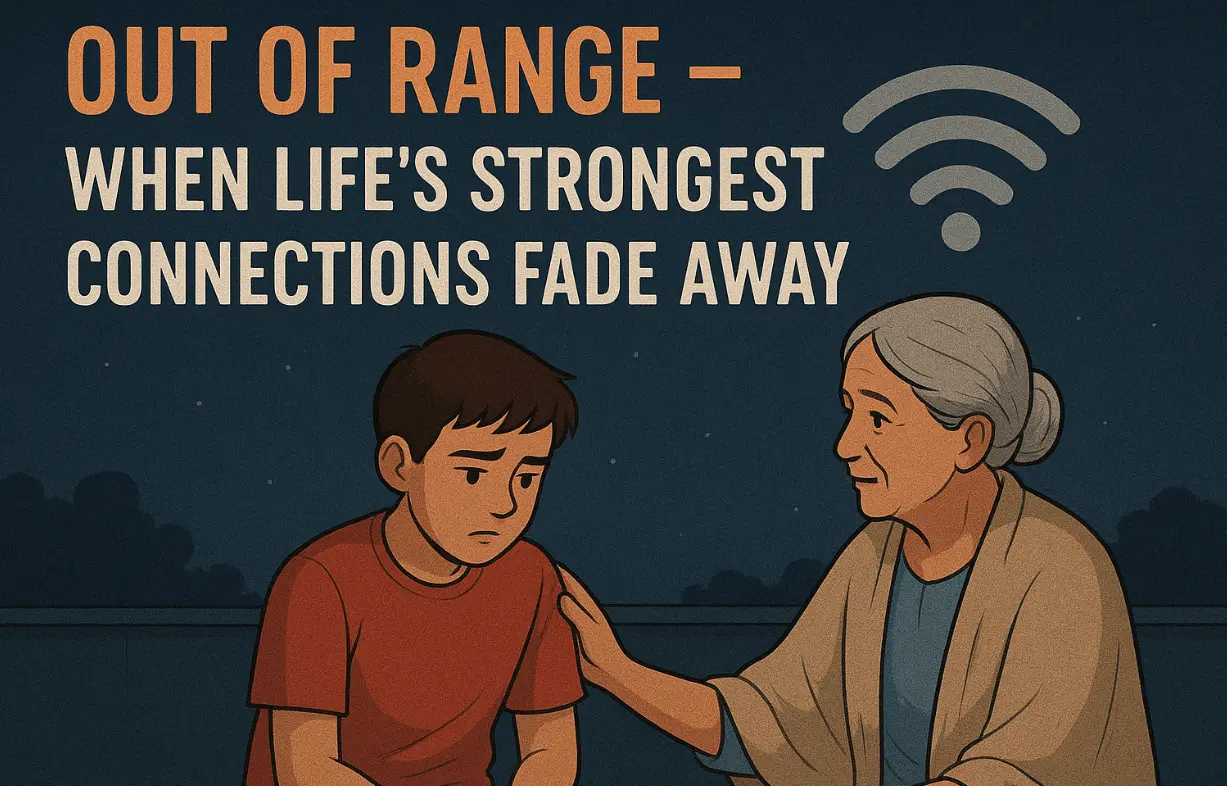
Out of Range – When Life’s Strongest Connections Fade Away. In a small town lived a boy named Aarav. As a child, Aarav was innocent, cheerful, and curious about the world. His parents often said that his heart was as pure as a morning dew drop. He laughed freely, trusted easily, and held on to every moral lesson taught by his parents and grandparents.
One day, Aarav’s father explained something to him in a very simple way. He pointed at the WiFi modem in their living room and said, “Do you see this modem, Aarav? As long as you stay close to it, the signal is strong. You can connect, play games, and learn anything you want. But if you move far away, the signal becomes weak. And if you go out of range completely, you lose the connection. Life is the same. Our values, our parents, our conscience—they are like this modem. Stay close, and you’ll always have guidance and strength.”
Aarav listened carefully and nodded. At that time, he understood only a little, but the example stayed in his mind.
Years passed. Aarav grew older. As a teenager, he began to step into a wider world—friends, temptations, distractions, and dreams bigger than his small town. Slowly, he started ignoring his parents’ advice. When his mother told him to come home early, he laughed it off. When his father reminded him to be honest in studies, he made excuses.
One evening, Aarav lied to his parents for the first time. He felt a sting in his heart, but his friends clapped him on the back and said, “See, you’re finally growing up!” Aarav smiled with them, but deep inside, he knew something was off. He had taken his first step “out of range.”
The connection to his parents’ values grew weaker. Like a mobile phone drifting too far from the modem, his moral strength started flickering. Small lies became bigger lies. Innocence gave way to clever tricks. The same boy who once laughed freely now learned to manipulate, to hide, to escape.
One night, Aarav’s grandmother saw him sitting alone on the terrace. She walked up to him and gently asked, “Why do you look so restless, Aarav?”
He shrugged. “I don’t know, Dadi. Everyone says I’m smart now, but I don’t feel happy.”
His grandmother smiled sadly and said, “You are restless because your heart has lost its connection. When you were little, your conscience was clear, like full signal strength. But slowly, you walked out of range. Tell me, whose fault is it when the internet doesn’t work? The modem’s or the person who went too far?”
Aarav looked at her in surprise. The old WiFi lesson flashed in his memory. He finally understood. It wasn’t the modem’s fault. It wasn’t even entirely his parents’ fault. He himself had walked away from the connection.
That night, Aarav couldn’t sleep. He thought of his childhood innocence, of the trust in his parents’ eyes, of the little joys he once had when life was simple. He realized he wanted that connection back.
The next morning, Aarav went to his parents. He admitted his mistakes, his lies, his choices. His father did not scold him. Instead, he hugged him and said, “The signal was always here, beta. You just had to come back into range.”
From that day, Aarav changed. It wasn’t easy. His old habits pulled him back, but he remembered the modem every time. Slowly, he rebuilt his connection with his family, his values, and most importantly, with his own conscience.
The story of Aarav became a gentle reminder for everyone around him. People realized that life often distracts us. Temptations, cleverness, and the rush of growing up make us drift out of range. But the truth is, the connection never dies—it only waits for us to return.
Moral
Life gives every person a “modem”—our parents, our values, our conscience. When we stay close, our signal is strong: we live honestly, peacefully, and with love. But when we drift away—chasing lies, selfishness, or wrong choices—we lose that strength.
Whose mistake is it then? Not the parents who kept the modem on. Not the values that were always present. It is the person who chose to go out of range. But the good news is, just like WiFi, the moment you come back closer, the connection revives.
Stay in range of your morals, your family, and your inner truth—because in the end, that is the real signal that keeps your life connected.
← The True Measure of Family: A Tale of Love, Responsibility, and Unity











Leave a Reply