
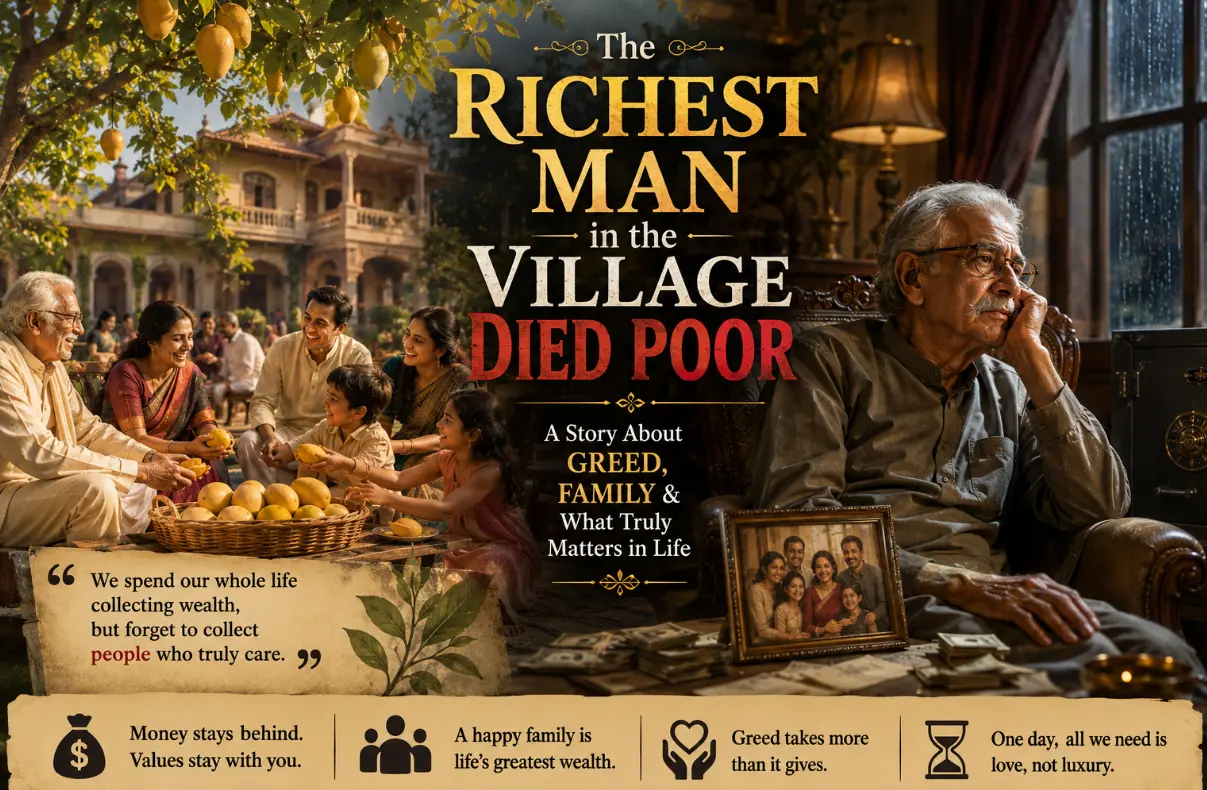
The Richest Man in the Village Died Poor: A Moral Story About Greed and Family.
Read a powerful moral story about greed and family that reveals how the pursuit of wealth can destroy relationships, peace, and the true meaning of happiness.
People often believed that poverty meant an empty wallet.
Very few realized that some of the poorest people leave behind overflowing bank accounts.
The old village of Ashwood had only one mansion.
Its marble floors gleamed under the morning sun.
Its gates stood taller than any house in the neighborhood.
Its gardens stretched farther than the eye could see.
Children passing by would stop and whisper,
“One day, I want a house like this.”
The mansion belonged to Raghav, a man admired for his success and feared for his obsession with wealth.
No one denied his intelligence.
He had built businesses from nothing.
He had bought land that later became priceless.
He had multiplied every opportunity life placed before him.
But somewhere along the journey, he began measuring everything by ownership.
Not happiness.
Not relationships.
Not kindness.
Ownership.
Whenever a discussion arose at home, it somehow ended with money.
Whenever a celebration was planned, he calculated the expense before noticing the smiles.
Whenever someone spoke about generosity, he replied,
“The world respects those who own more.”
His children grew up listening.
Children are remarkable observers.
They rarely become what parents tell them to be.
They often become what parents repeatedly show them.
Raghav never taught greed through lessons.
He taught it through example.
His sons learned to compare.
His daughters learned to calculate.
Every conversation slowly became,
“Whose room is bigger?”
“Who received more?”
“Why should I share?”
The family still lived under one roof.
But the home had quietly begun dividing itself long before its walls ever did.
Years passed.
The family’s old mango tree stood proudly in the center of the courtyard.
It had been planted by Raghav’s father decades earlier.
Every summer, it produced baskets of sweet mangoes.
When Raghav was a child, neighbors gathered beneath its shade.
Children climbed its branches.
Women laughed while preparing pickles.
No one counted how many mangoes each family took home.
The tree gave freely.
So did the people.
But times had changed.
One morning, Raghav instructed the gardener,
“Count every basket.”
“No one takes extra.”
“Lock the storage room.”
The gardener looked surprised.
“But sir… we’ve always shared with everyone.”
Raghav replied firmly,
“Not anymore.”
That afternoon, the courtyard felt strangely silent.
The tree still offered its fruit.
But no laughter gathered beneath its branches.
The mangoes had not changed.
The hearts had.
Months later, Raghav noticed something unexpected.
His own children had begun arguing over everything.
One wanted a larger share of the business.
Another secretly sold family land without informing the others.
A third stopped speaking to the family altogether over inheritance.
Every conversation became a negotiation.
Every festival became uncomfortable.
Every meal ended with disagreement.
One evening, Raghav’s elderly mother quietly looked at him and said,
“Greed never enters a house carrying a weapon. It enters carrying a measuring tape. It measures rooms, land, wealth… until one day, it measures the distance between hearts.”
Those words lingered.
But pride often speaks louder than wisdom.
Raghav ignored them.
The years continued their silent work.
The businesses expanded.
The mansion became larger.
The bank accounts multiplied.
Yet birthdays became smaller.
Festivals became quieter.
Family photographs became fewer.
His grandchildren preferred vacations over visiting home.
Some called only when paperwork needed signatures.
Others spoke politely but hurriedly.
No one argued anymore.
Not because peace had returned.
Because affection had quietly left.
Time, however, teaches lessons no human can escape.
At seventy-eight, Raghav’s health began to fail.
The doctors advised rest.
The meetings stopped.
The property deals slowed.
For the first time in decades…
Silence filled his calendar.
He sat beside the large living-room window overlooking the same mango tree his father had planted.
Its branches still swayed gracefully in the breeze.
Children from neighboring houses laughed outside the gates.
Inside…
The mansion echoed.
One afternoon, he asked an old servant,
“Why doesn’t anyone sit in the courtyard anymore?”
The servant hesitated.
Then answered honestly.
“Sir… people stopped gathering when sharing stopped.”
Raghav looked toward the tree for a very long time.
It still gave fruit every season.
It had never become greedy.
Only its owner had.
One rainy evening, while organizing an old cupboard, Raghav discovered a faded family photograph.
His father stood beneath the mango tree.
Neighbors surrounded him.
Children laughed with juice running down their hands.
No one looked wealthy.
Everyone looked happy.
He stared at the picture until tears quietly filled his eyes.
For the first time, he realized something that wealth had hidden from him for years.
“The tree never stopped giving. We simply stopped sharing its shade.”
Days turned into weeks.
His illness slowly worsened.
His children visited.
Some came out of duty.
Some discussed legal documents between hospital visits.
Some stayed only briefly before rushing back to their own lives.
They weren’t cruel.
They simply treated relationships the same way they had been taught.
Transactionally.
One evening, his eldest son gently asked,
“Dad… do you need anything?”
Raghav looked around the quiet room.
The expensive furniture.
The imported paintings.
The polished marble floor.
The safe filled with documents that had once consumed his entire life.
Then he smiled sadly.
“No.”
His son nodded and left.
What Raghav truly wanted to say remained trapped inside his heart.
“I don’t need anything anymore.”
“I only wish I hadn’t spent my whole life confusing wealth with love.”
The following morning, his youngest granddaughter visited alone.
She quietly held his hand.
Neither spoke for several minutes.
Then she asked,
“Grandpa…”
“Were you always this rich?”
He smiled weakly.
“Yes.”
She thought for a moment.
“Were you always this lonely?”
The room became silent.
Sometimes the simplest questions carry the heaviest answers.
That evening, Raghav requested to be taken to the courtyard.
With slow steps and trembling hands, he walked toward the old mango tree.
He gently placed his palm against its trunk.
The bark felt rough.
Familiar.
Comforting.
He closed his eyes.
For a moment, he could almost hear the laughter that once filled the courtyard decades earlier.
He whispered softly,
“I spent my life collecting things that couldn’t cry when I left… and neglected the people who would have.”
The breeze carried the scent of ripe mangoes through the air.
Nature had never forgotten how to give.
Only people sometimes did.
A few weeks later, Raghav passed away peacefully.
The mansion remained.
The businesses continued.
The bank accounts stayed exactly where they were.
Nothing material followed him.
But something else remained behind.
A handwritten letter found inside his desk.
It contained only a few lines.
“If my grandchildren inherit anything from me, let it not be my wealth before it is my wisdom.”
“Teach them that success without generosity becomes loneliness wearing expensive clothes.”
“Never fight over what cannot accompany you beyond your final breath.”
“Protect your family more carefully than your fortune, because one day your fortune will remain behind… but your family will decide whether your memories are spoken with gratitude or regret.”
Years later, Raghav’s grandchildren gathered beneath the old mango tree once again.
This time, there were no locked storerooms.
No counted baskets.
No arguments over who deserved more.
The fruit was shared freely.
Children climbed the branches.
Neighbors laughed together.
Someone remarked,
“It feels just like the old days.”
Perhaps the greatest inheritance Raghav left behind was not the mansion.
It was the lesson he understood almost too late.
Greed never destroys a family in a single day.
It arrives quietly.
One comparison.
One selfish decision.
One unnecessary possession at a time.
Until love begins keeping score.
And the moment a family starts counting shares more carefully than blessings…
Peace quietly packs its bags.
Because the richest life is not measured by how much we own.
It is measured by how many hearts still feel at home when they walk through our door.
Money can buy comfort.
It cannot buy the hand that willingly stays beside yours when your own hands grow weak.
The wealth that truly matters is never locked inside a safe.
It lives inside the people who choose to remain by your side… long after everything else has lost its value.
← Trust Is Built in Drops. Lost in Buckets. | A Moral Story About Trust












Leave a Reply