
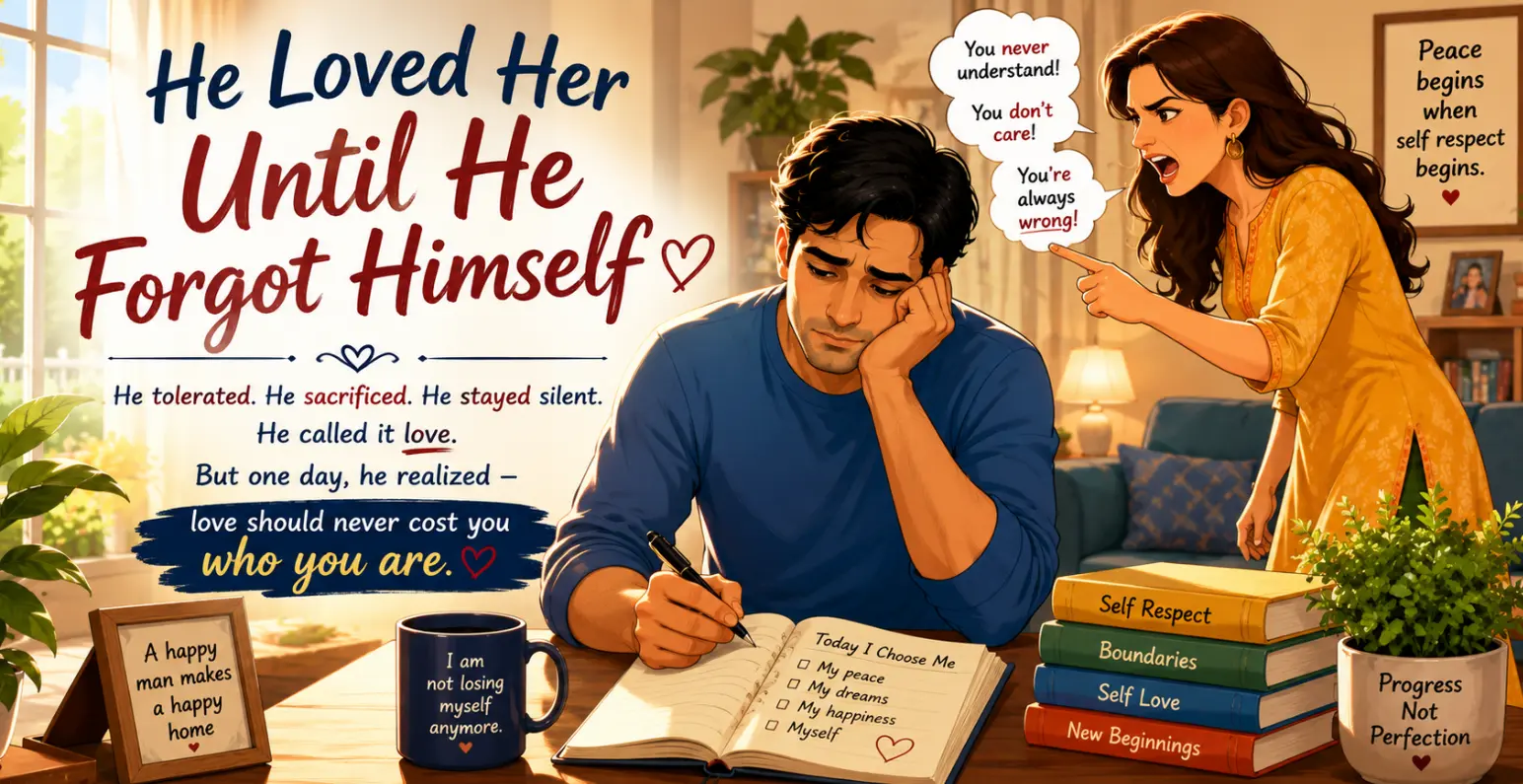
When Love Becomes the Reason You Lose Yourself. A powerful moral story about a husband who tolerates everything for love until he realizes that saving a relationship should never mean losing yourself.
Daniel was the kind of husband people admired.
He never raised his voice.
He never embarrassed his wife in front of others.
He remembered birthdays, paid the bills, took care of responsibilities and made sure there was always food on the table.
Whenever someone praised him for being a devoted husband, Daniel simply smiled.
He never told them what happened after the front door closed.
Because inside his beautiful home lived a version of Daniel nobody knew.
A tired man.
A frightened man.
A man who had slowly learned to measure every word before speaking.
His wife, Clara, was rarely satisfied.
If Daniel came home early, she complained that he was interfering with her routine.
If he came home late, she accused him of not caring about his family.
If he bought something for himself, she called him selfish.
If he spent money on his parents, she questioned his priorities.
If he remained silent during an argument, she called him weak.
And if he finally tried to defend himself, she would say,
“You have changed.”
Daniel hadn’t changed.
He had simply become exhausted.
At the beginning of their marriage, Daniel believed that every difficult relationship could be healed with patience.
So he tolerated the small things.
Then the bigger things.
Then the things he once believed he would never tolerate.
Whenever Clara hurt him, he told himself,
“She’s angry.”
“She had a difficult day.”
“Maybe I misunderstood her.”
“Marriage requires compromise.”
He kept finding explanations for behavior that was slowly breaking him.
Because Daniel loved her.
And love, in his mind, meant staying.
His friends began noticing the difference.
The man who once laughed loudly had become quiet.
The man who once dressed with confidence now looked constantly tired.
The man who once had opinions about everything had started saying the same sentence whenever someone asked what he wanted:
“Whatever is fine.”
One evening, his childhood friend Michael asked him,
“Daniel, what happened to you?”
Daniel smiled.
“Nothing.”
“You don’t laugh anymore.”
“I’m just busy.”
“You don’t make decisions anymore.”
“I don’t mind.”
“You don’t even argue anymore.”
Daniel looked away.
“What’s the point?”
Michael stared at him.
That answer frightened him more than anger would have.
Because anger meant Daniel was still fighting.
Indifference meant he had begun surrendering.
Years passed.
Daniel stopped meeting friends because Clara disliked them.
He stopped visiting certain relatives because she accused them of influencing him.
He stopped buying things he liked because every personal expense became an argument.
He stopped expressing disagreement because every disagreement became a battle.
Eventually, he stopped asking himself what he wanted.
That was when something inside him truly changed.
He hadn’t merely surrendered his choices.
He had surrendered his identity.
“A person does not disappear in a relationship all at once. Sometimes they disappear one compromise at a time.”
One Sunday morning, Daniel stood before the mirror.
He was forty-two years old.
He looked at his reflection for several seconds.
Then he asked himself a question he hadn’t asked in years.
“Who am I?”
The answer didn’t come.
He knew what Clara wanted.
He knew what his family expected.
He knew what his colleagues needed.
He knew what his parents hoped for.
But he didn’t know what Daniel wanted anymore.
He had spent so many years keeping everyone else comfortable that he had forgotten what his own comfort felt like.
That realization frightened him.
That afternoon, Daniel went to a quiet park.
An elderly man was sitting beneath a tree, feeding birds.
Daniel sat nearby.
After a while, the old man said,
“You look like someone carrying a house on his shoulders.”
Daniel gave a tired laugh.
“Sometimes it feels that way.”
“Why don’t you put it down?”
“I can’t.”
“Why?”
“Because people live inside it.”
The old man looked at him.
“People can live inside your heart without being allowed to live on top of you.”
Daniel remained silent.
The old man continued,
“There is a difference between carrying someone you love and allowing them to crush you.”
Something inside Daniel broke open.
Not painfully.
Almost peacefully.
For the first time, someone had given him permission to recognize his own suffering.
That evening, Daniel went home.
Clara began another argument.
Usually, Daniel would apologize.
This time, he didn’t.
She waited.
Daniel spoke quietly.
“I love you.”
She looked surprised.
“But I cannot continue living like this.”
Her expression hardened.
“So now you blame me?”
“No.”
“Then what do you want?”
Daniel took a breath.
“I want to exist.”
Silence filled the room.
“I want to have an opinion without being punished for it. I want to see my family without feeling guilty. I want to make ordinary decisions without being afraid of your reaction. I want to be your husband, not your prisoner.”
Clara stared at him.
For once, Daniel didn’t try to soften his words.
He wasn’t being cruel.
He was being honest.
Nothing changed overnight.
Clara didn’t suddenly become a different person.
Daniel didn’t suddenly become fearless.
But something inside him had shifted.
He began setting boundaries.
He began reconnecting with people he had pushed away.
He began taking care of his health.
He began doing things he enjoyed.
He started speaking when something hurt him.
And most importantly…
he stopped confusing silence with peace.
Because silence had never healed his marriage.
It had only hidden its wounds.
Months later, Daniel stood in the same park where he had met the old man.
He looked calmer.
Not because his life had become perfect.
Because he had finally stopped abandoning himself.
The old man was there again.
“You look different.”
Daniel smiled.
“I found myself.”
“Where?”
Daniel thought for a moment.
“Underneath all the things I surrendered.”
The old man nodded.
Daniel eventually understood something that had taken him years to learn.
Marriage requires patience.
It requires forgiveness.
It requires compromise.
But compromise has a boundary.
You can bend without breaking.
You can forgive without accepting repeated harm.
You can love someone deeply without surrendering your entire identity to them.
And you can remain compassionate without allowing someone else’s behavior to destroy your sense of worth.
“There is a difference between sacrificing for love and sacrificing yourself to love.”
Daniel had spent years believing that the greatest proof of his love was how much pain he could tolerate.
He finally realized he had been measuring love incorrectly.
Love isn’t proven by how much of yourself you can destroy for another person.
Love is proven by how two people can protect each other’s dignity while building a life together.
Years later, Daniel would tell anyone going through a difficult relationship:
“Don’t wait until you no longer recognize yourself.”
“Don’t mistake fear for loyalty.”
“Don’t call self-erasure sacrifice.”
“And don’t believe that loving someone gives them the right to own your peace.”
Because Daniel knew something now that he wished he had understood much earlier.
“The saddest kind of loneliness is not being alone. It is becoming a stranger to yourself while living beside the person you love.”
He had once thought that leaving himself behind was the price of keeping his marriage alive.
Now he understood the truth.
A relationship can survive disagreement.
It can survive hardship.
It can survive mistakes.
But when one person must disappear completely for the other person to remain comfortable…
something is no longer being preserved.
It is being destroyed.
Daniel had spent years trying to save his marriage.
In the end, the first person he needed to save was himself.
And that was not selfishness.
It was the beginning of self-respect.
Because sometimes the most courageous thing a person can say is not,
“I don’t love you anymore.”
Sometimes it is:
“I love you, but I will not lose myself anymore.”
← The Man Who Lived in Dirt, Yet Carried a Heart Full of Love | Moral Story









Leave a Reply