
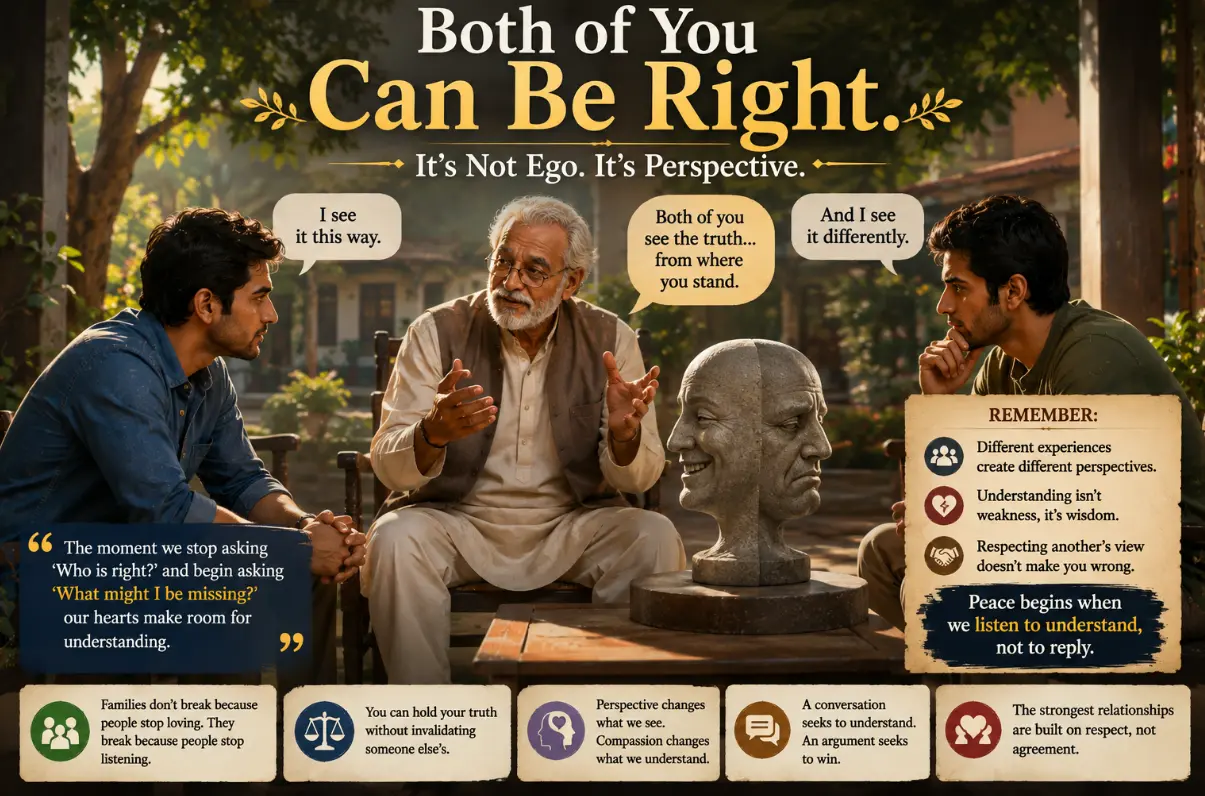
Both of You Can Be Right. It’s Not Ego. It’s Perspective. Can two people be right in the same argument? Explore a heartwarming moral story about perspective, empathy, and preserving family relationships.
There was once a small village where people often visited an old teacher named Anand.
He wasn’t famous for solving arguments.
He was famous for ending them.
Whenever two people walked into his courtyard, they usually entered carrying anger and left carrying silence.
Not the uncomfortable silence of resentment.
The peaceful silence that comes after understanding.
One summer afternoon, two brothers arrived at his doorstep.
Arjun and Karan had grown up sharing the same room, the same meals, the same dreams, and the same parents.
Yet somewhere along the journey called life, they had stopped sharing their hearts.
Neither remembered how the argument had truly begun.
One believed he had been misunderstood.
The other believed he had been ignored.
Months had passed without a proper conversation.
Their parents suffered quietly.
Family dinners became shorter.
Festivals lost their laughter.
Everyone wanted peace.
No one wanted to be the first to bend.
Because each brother believed only one thing.
“I am right.”
The old teacher welcomed them inside without asking a single question.
Instead of offering advice, he led them into a beautiful garden.
At the center stood a magnificent stone sculpture.
It was unlike anything they had ever seen.
“Stand here,” Anand told Arjun.
Then he guided Karan to the opposite side of the sculpture.
“What do you see?” he asked.
Arjun smiled.
“A joyful face.”
Karan immediately frowned.
“What?”
“It’s clearly a sad face.”
Arjun laughed.
“You’re joking.”
“No.”
“You just don’t want to admit you’re wrong.”
Karan folded his arms.
“No… you refuse to see what’s obvious.”
Within seconds, another argument had begun.
The old teacher quietly listened.
Then he simply said,
“Switch places.”
The brothers looked confused.
But they obeyed.
The moment Arjun stood where Karan had been standing…
His expression changed.
The joyful face had disappeared.
Now the sculpture truly looked sorrowful.
Across the garden, Karan stared in disbelief.
From his new position…
He saw exactly what Arjun had described earlier.
Neither spoke.
For several moments…
The garden remained completely still.
Finally, Anand smiled.
“Were either of you lying?”
Both brothers shook their heads.
“Were either of you wrong?”
Again…
They slowly shook their heads.
The old teacher walked toward the sculpture and gently rested his hand upon it.
“The sculpture never changed.”
“Only your position did.”
The brothers remained silent.
Then Anand continued,
“Most family arguments are exactly like this.”
“People don’t fight because one person always lies.”
“They fight because each person mistakes their own perspective for the complete truth.”
Those words settled deeply inside both hearts.
The old teacher invited them to sit beneath an old banyan tree.
Its branches stretched in every direction.
“No branch grows exactly like another,” he said.
“Yet together…”
“They become one tree.”
He looked at the brothers kindly.
“You have spent months trying to prove who was right.”
“What if you asked a different question?”
They looked at him.
“What question?”
He smiled.
“What if both of you are right?”
The brothers looked puzzled.
“How can that be possible?”
Anand replied,
“Because life is not experienced through identical eyes.”
“Every person carries different memories.”
“Different fears.”
“Different expectations.”
“The same event can touch two hearts in completely different ways.”
He picked up two cups from a nearby table.
One contained warm water.
The other held cold water.
He asked Arjun to place one hand in each cup.
Then he asked him to place both hands into a bowl of room-temperature water.
“The bowl feels warm.”
Karan repeated the experiment in reverse.
To him…
The very same bowl felt cold.
The brothers laughed.
“The water didn’t change.”
Anand smiled.
“Exactly.”
“Your previous experience changed the way you felt it.”
He paused before adding,
“People are no different.”
That afternoon, the old teacher shared a few thoughts neither brother would ever forget.
“The greatest mistake in an argument is believing that understanding another person’s truth requires abandoning your own.”
Another silence followed.
Then he said,
“Families rarely break because people stop loving one another. They break because people stop listening long enough to understand why the other person feels the way they do.”
The breeze gently moved through the leaves above them.
Even nature seemed to pause.
Arjun looked toward his brother.
“For months…”
“I thought admitting your feelings meant admitting I was wrong.”
Karan quietly nodded.
“So did I.”
The old teacher smiled.
“You confused understanding with surrender.”
“They are not the same.”
“You can say…”
‘I understand why you feel hurt.’
“…without saying…”
‘My own pain never existed.’
Both truths can live together.
As the sun slowly began setting, Anand drew a circle in the sand.
Then he asked each brother to stand on opposite sides again.
“What shape do you see?”
“A line,” Arjun answered.
“A curve,” Karan replied.
The old teacher erased the drawing with his foot.
“It was always a circle.”
“You simply saw different parts of it.”
He looked into their eyes.
“Perspective decides what your eyes notice.”
“Compassion decides whether your heart is willing to walk around the circle.”
The brothers sat quietly for a long time.
Finally, Arjun broke the silence.
“I’m sorry.”
Karan immediately replied,
“So am I.”
The old teacher gently interrupted them.
“No.”
They both looked surprised.
“Don’t apologize because you were wrong.”
“Apologize because the relationship became less important than proving you were right.”
The brothers lowered their heads.
For the first time…
Neither wanted to win.
Both wanted to heal.
Months later, something remarkable happened.
The disagreements didn’t disappear.
The brothers still viewed life differently.
One remained practical.
The other remained emotional.
One preferred caution.
The other preferred risk.
But whenever a disagreement arose, one sentence echoed inside both their minds.
“Let me stand where you’re standing before I decide what you see.”
That single thought changed everything.
Arguments became conversations.
Defensiveness became curiosity.
Silence became understanding.
Years later, after Anand had passed away, the two brothers placed a sculpture in the courtyard of their family home.
Visitors often admired it.
Children asked why it looked different from every angle.
The brothers would smile and answer,
“It reminds us that truth sometimes wears more than one face.”
Then they would tell the story of an old teacher who never taught them how to win arguments.
He taught them something far more valuable.
How to protect relationships.
Because peace does not begin when one person finally says,
“I was wrong.”
Peace begins when two people quietly admit,
“Perhaps I haven’t seen the whole picture yet.”
And perhaps that is the greatest wisdom a family can ever learn.
Not every disagreement is a clash of egos.
More often…
It is a clash of perceptions.
The moment we stop asking,
“Who is right?”
and begin asking,
“What might I be missing?”
our hearts make room for understanding.
For the strongest relationships are not the ones where everyone always agrees.
They are the ones where everyone feels seen, heard, and respected—even when they see the world differently.
Because sometimes…
both people are right.
They were simply standing on opposite sides of the same truth.
← The Richest Man in the Village Died Poor: A Moral Story About Greed and Family




Leave a Reply